17mm to Inches: Exact Conversion, Formula, Chart, and Practical Examples
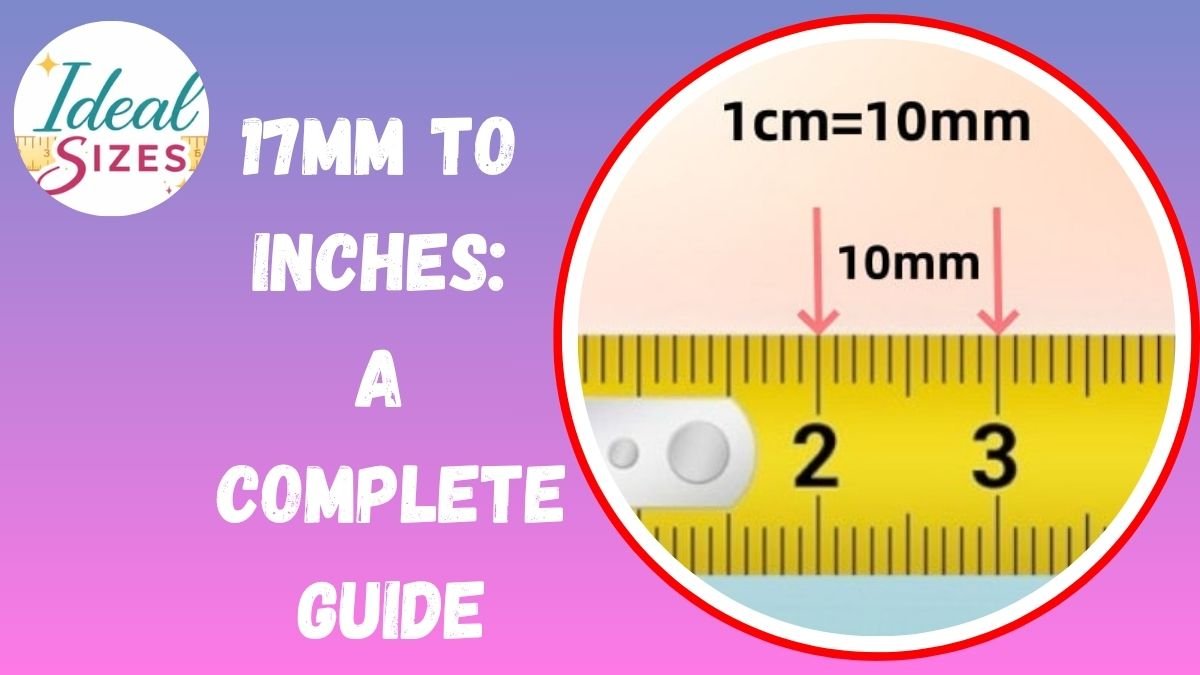
If you’ve ever wondered how to convert 17 mm to inches, you’re in the right place. The exact value is 0.669291 inches, which rounds to 0.669 inches or 0.67 inches. Knowing how to convert millimeters to inches is essential for various tasks, from DIY projects to precise measurements in science.
In this article, we’ll cover the 17mm to inches conversion, including the exact value, the conversion formula, step-by-step calculations, fraction equivalents, conversion charts, real-world examples, and frequently asked questions.
What Is 17mm in Inches?
17 mm equals 0.669291 inches. A common rounded figure of 17 millimeters to inches is 0.67 inches. When converting metric measurements, it helps to put them into context. It is slightly more than 5/8 inch, which is exactly 0.625 inches. A close fractional equivalent is 11/16 inch, which equals 0.6875 inches.
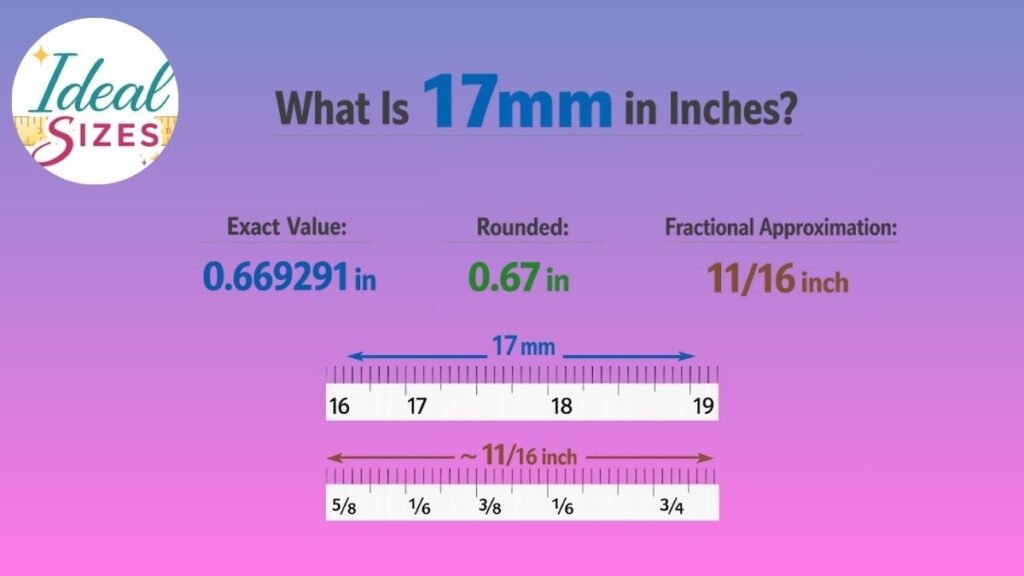
17mm to Inches at a Glance
| Measurement | Equivalent |
| 17 mm | 0.669291 in |
| Rounded to 3 decimals | 0.669 in |
| Rounded to 2 decimals | 0.67 in |
| Approx. fraction | 11/16 in |
| Centimeters | 1.7 cm |
How to Convert 17mm to Inches?
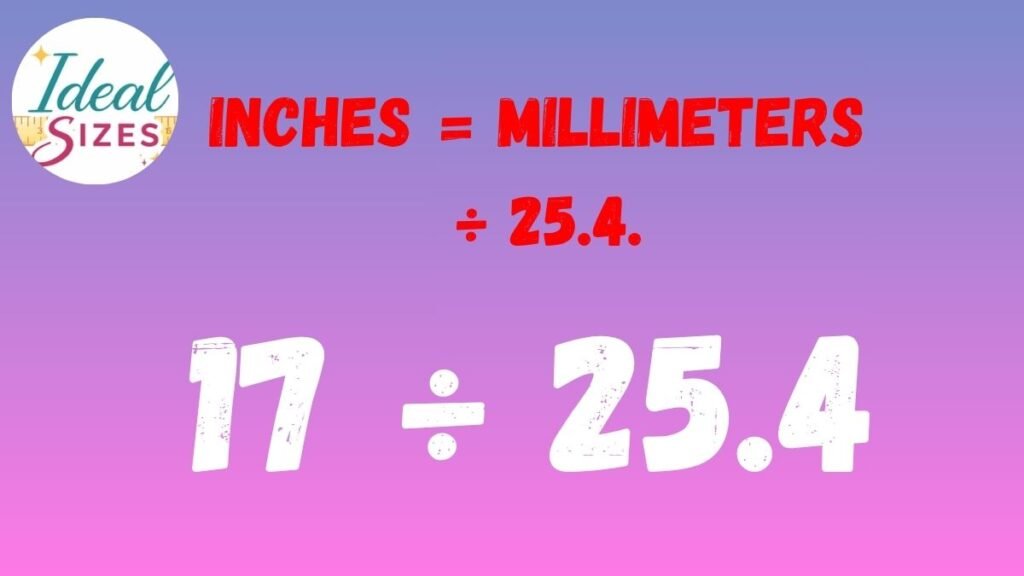
To convert millimeters to inches, use the formula: Inches = Millimeters ÷ 25.4. If you want to convert 17 mm into inches, divide 17 by 25.4, as 1 inch equals 25.4 millimeters. Doing the math, you find that 17 ÷ 25.4 equals approximately 0.669291 inches.
Step-by-Step Conversion of 17mm to Inches
- To convert 17 mm to inches, start with the formula: Inches = mm ÷ 25.4. This is your trusty guide for converting measurements.
- Just plug in the value by calculating 17 ÷ 25.4. It’s a simple step that prepares you for the division ahead.
- Next, do the math: dividing 17 by 25.4 gives you approximately 0.669291. This number may seem lengthy, but it represents a precise measurement.
- If you want to simplify it, round it to 0.669 inches, or 0.67 inches.
17mm in Fractional Inches
When we convert 17 mm to inches, it equals approximately 0.669291 inches. This figure may seem a bit tricky when related to common fractional inches. To simplify, let’s consider two fractions: 5/8 inch and 11/16 inch. The 5/8 inch is roughly 0.625 inches, while 11/16 inch measures around 0.6875 inches.
Comparing these values, 17 mm falls closer to 11/16 inch. Understanding these conversions is handy, especially when working on DIY projects or measurements. Knowing that 17 mm is nearly equivalent to 11/16 inch can save time and reduce errors.
| Fraction | Decimal | Difference from 17 mm |
| 5/8 in | 0.625 | 0.0443 in |
| 11/16 in | 0.6875 | 0.0182 in |
| 3/4 in | 0.75 | 0.0807 in |
17mm to Inches Conversion Chart
A conversion chart serves as a handy reference. It makes it easy to switch between these units without any hassle. It can save time when you’re in a hurry and need quick answers. Understanding these conversions can also enhance your communication with others, especially in global collaborations.
| Millimeters | Inches | Approx. Fraction |
| 10 mm | 0.394 in | 13/32 in |
| 12 mm | 0.472 in | 15/32 in |
| 14 mm | 0.551 in | 9/16 in |
| 15 mm | 0.591 in | 19/32 in |
| 16 mm | 0.630 in | 5/8 in |
| 17 mm | 0.669 in | 11/16 in |
| 18 mm | 0.709 in | 23/32 in |
| 19 mm | 0.748 in | 3/4 in |
| 20 mm | 0.787 in | 25/32 in |
| 25 mm | 0.984 in | 1 in |
17mm to Inches and Other Common Units
| Unit | Equivalent to 17 mm |
| Inches | 0.669291 in |
| Rounded inches | 0.67 in |
| Centimeters | 1.7 cm |
| Meters | 0.017 m |
| Micrometers | 17,000 µm |
How Big Is 17mm?
Seventeen millimeters is a small measurement. It is approximately 1.7 centimeters or 0.669 inches. It’s slightly more than 5/8 inch (15.875 mm) and under 11/16 inch (17.4625 mm). It is a common size in hardware and mechanical components, often found in screws, nuts, and bolts used in everyday projects.
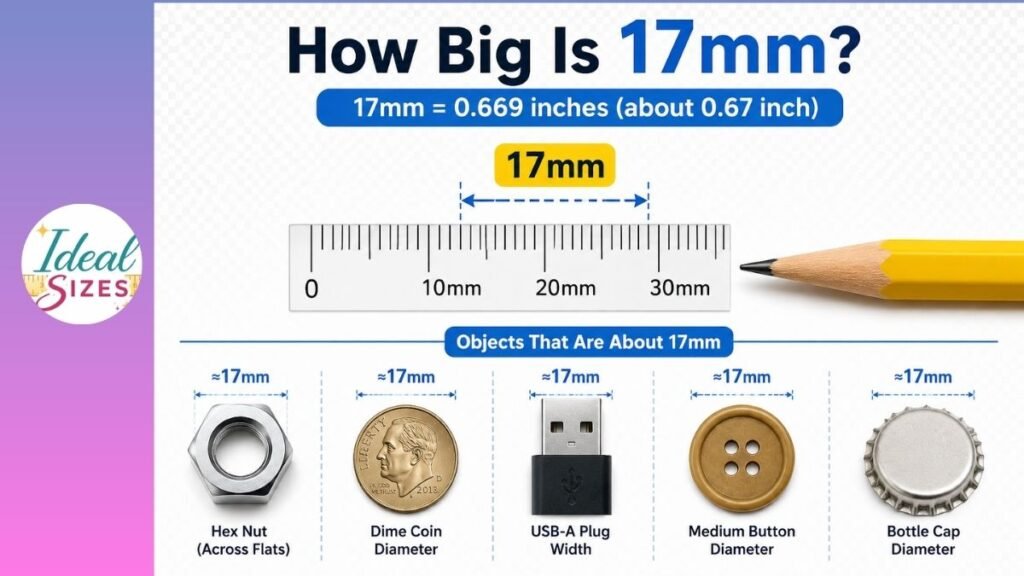
Common Uses of 17mm Measurements
The 17mm measurement often pops up in various everyday scenarios. Here are some of the most common uses of this measurement.
17mm in Automotive and Mechanical Work
In automotive and mechanical work, 17 mm is a common measurement. 17 mm sockets are often used for nuts and bolts in car engines, suspension systems, and general repairs. These sockets are essential for achieving the right torque when tightening bolts.
17mm in Construction and Hardware
In construction, 17 mm measurements play a vital role in ensuring components fit together properly. Many metric hardware items, like screws and anchors, come in this size. Builders and contractors rely on these measurements to create sturdy structures. Whether it’s assembling furniture or constructing frameworks, the 17 mm size is often part of the equation.
17mm in Manufacturing
In manufacturing, 17mm measurements are essential for creating precision parts and adhering to strict specifications. For instance, many mechanical components, such as gears or bushings, require exact dimensions for proper fit and function. When engineers design these items, they often specify 17mm to ensure compatibility with other parts. This level of precision reduces friction and wear.
17mm in DIY Projects
For DIY enthusiasts, knowing that 17mm equates to about 0.67 inches is useful. Many projects involve combining metric and imperial measurements, and having this conversion makes it easier to choose the right tools and materials. Whether you’re cutting wood, fitting pipes, or assembling furniture, understanding 17mm helps avoid mistakes.
17mm in Crafting and Other Measurements
Crafting often requires precise measurements to ensure the quality of the final product. For example, when creating custom jewelry or assembling model kits, a 17mm measurement might be used for specific components like beads or connectors. While you may not find 17mm items everywhere, being aware of this measurement helps crafters select the right pieces for their projects.
17mm vs Common Inch Measurements
When it comes to 17mm vs. common inch measurements, understanding the differences can enhance your DIY projects and daily tasks. The metric system, with millimeters, is used widely across the globe, while the imperial system relies on inches, with 1 inch equal to 25.4mm. This relationship can be a game-changer for anyone moving between the two systems.
| Measurement | Inches | Compared with 17 mm |
| 1/2 inch | 0.500 | Smaller |
| 9/16 inch | 0.5625 | Smaller |
| 5/8 inch | 0.625 | Smaller |
| 17 mm | 0.6693 | — |
| 11/16 inch | 0.6875 | Slightly larger |
| 3/4 inch | 0.750 | Larger |
Is 17mm the Same as 11/16 Inch?
No, 17mm is not the same as 11/16 inch. 17mm converts to about 0.669 inches, while 11/16 inch equals 0.6875 inches. This means there’s a small difference of approximately 0.0182 inches between the two measurements. So, if you’re working on a project that requires exact measurements, relying on this slight difference could lead to issues down the line.
Common Mistakes When Converting 17mm to Inches
Converting 17mm to inches can seem straightforward, but common mistakes often lead to confusion. Here are a few pitfalls to avoid:
- When converting 17mm to inches, one error is using 25 instead of 25.4 for the conversion factor. Remember, 1 inch equals 25.4 millimeters, so using 25 changes your results.
- Multiplying instead of dividing: To convert millimeters to inches, divide the millimeter value by 25.4. If you multiply instead, you’ll end up with a much larger number than intended. Some people confuse millimeters with centimeters. A millimeter is one-tenth of a centimeter, so getting these units mixed up can lead to errors.
- Rounding too early can skew results. If you round during the conversion process before reaching the final number, you might end up with inaccuracies. Always complete your calculations before rounding the final result.
- Treating an approximate fraction as an exact conversion is another frequent error. While 1 inch approximates 25.4 mm, it’s better to use precise values in calculations for accuracy.
- Mixing metric and imperial units can create chaos. Ensure that all parts of your calculation are in the same system before converting. Consistently working in either metric or imperial units simplifies the process and reduces errors.
- Using inconsistent decimal precision in your calculations can be confusing. It’s wise to maintain a consistent number of decimal places throughout your work. This will help keep your results clear and reliable.
By paying attention to these common mistakes, you can confidently convert measurements and avoid frustrating errors.
Why Accurate mm-to-Inch Conversion Matters
Accurate mm-to-inch conversion is essential in many fields, from construction to cooking. Even a small error can lead to mismatched parts or ill-fitting furniture. Here are some fields where accurate conversion matters.
- Accurate mm-to-inch conversion is essential in engineering. Precision is key when designing components that must fit together perfectly. A small error can lead to misalignment and costly redesigns.
- In manufacturing, small discrepancies can affect mass production. Tools and machinery must be calibrated accurately. Incorrect conversions can slow down production and increase waste.
- For automotive repair, knowing the exact dimensions can mean the difference between a smooth-running engine and mechanical failure. It ensures that parts fit correctly and promotes safety and reliability.
- In construction, measurements must be spot-on. Builders use both metric and imperial systems. Miscalculations can result in structural issues or increased costs that arise from fixing mistakes.
- DIY enthusiasts also benefit from precise conversions. When following plans from different countries, accurate measurements avoid frustration and wasted materials.
- International product specifications often require both metric and imperial dimensions.
- Hardware compatibility hinges on accurate conversions. Whether installing new fixtures or machinery, precise measurements save time and effort.
Conclusion
17 mm is exactly 0.669291 inches when converted. If you prefer a rounded conversion, it’s approximately 0.67 inches. Understanding how to convert 17 millimeters to inches is quite simple. To convert millimeters to inches, you can use the formula: inches = millimeters ÷ 25.4. As a fractional approximation, 17 mm is close to 11/16 of an inch. This conversion is useful for anyone working with tools or materials that use different measurement systems. Understanding these conversions can help you make accurate measurements in your projects.
FAQs
What is 17mm in inches exactly?
Seventeen millimeters is exactly 0.6692913386 inches. This value comes from the conversion factor between millimeters and inches, where 1 millimeter equals about 0.0393701 inches.
What is 17 mm rounded to Inches?
To convert millimeters to inches, use the conversion factor 1 inch equals 25.4 millimeters. For 17 mm, divide 17 by 25.4. It is approximately 0.67 inches.
What Fraction is Closest to 17mm?
17 mm is closest to 11/16 inch. Since 17 mm equals about 0.669 inches, it is close to 11/16 inch (0.6875 inches).
What is 17mm in Centimeters?
To convert millimeters to centimeters, use a simple formula. There are 10 millimeters in a centimeter. So, to find out how many centimeters are in 17 millimeters, divide by 10. 17 mm ÷ 10 is 1.7 cm. Thus, 17 millimeters equals 1.7 centimeters.
How do you convert mm to Inches?
To convert millimeters (mm) to inches, use a calculation. The basic formula is to divide the number of millimeters by 25.4. This is because one inch is equal to 25.4 millimeters. For example, if you have 50 mm and want to convert it to inches, you would do the math like this: 50 mm ÷ 25.4 = 1.9685 inches. You can round this to 1.97 inches for simplicity.
What is the Formula for Converting 17mm to Inches?
To convert millimeters (mm) to inches, divide the number of millimeters by 25.4 because there are 25.4 millimeters in an inch. To convert 17 mm to inches, you would calculate: 17 ÷ 25.4. This results in approximately 0.6693 inches. So, 17 mm is a little less than two-thirds of an inch.