14mm to Inches: Exact Conversion, Formula, Chart, and Practical Examples
Many people struggle with converting millimeters to inches. This small measurement can make a big difference in engineering and construction. 14mm is equal to approximately 0.551 inches. Understanding this conversion is essential for anyone working in fields such as construction, crafting, or engineering.
This article covers everything you need to know about the conversion from 14mm to inches. You will learn the straightforward method for converting 14mm to inches, the exact conversion, formula, chart, and practical examples. By the end, you’ll be equipped to tackle any metric-to-inch conversion without stress.
What is 14mm in Inches?
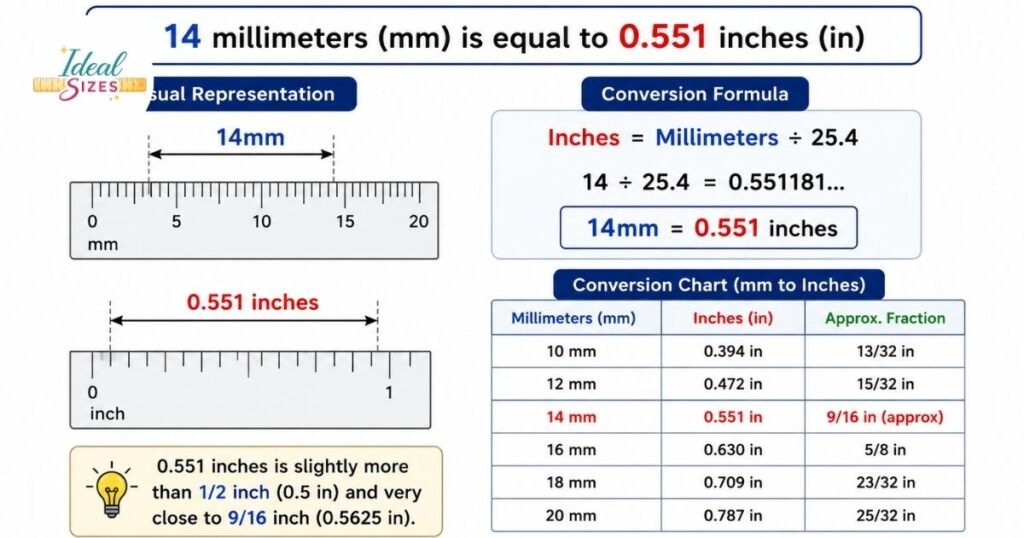
14 mm converts to approximately 0.551 inches. For everyday use, we often round this to 0.55 inches. It is a bit more than half an inch. It falls short of 9/16 of an inch, which measures 0.5625 inches. In engineering and hardware, 14 mm is a medium-small measurement. You’ll commonly find this size used in bolts, mechanical parts, and the thickness of certain jewelry pieces.
Understanding the Conversion System
The conversion system between the metric and imperial systems is essential for effective communication in various fields. The metric system uses millimeters (mm), centimeters (cm), and meters (m), whereas the imperial system relies on inches, feet, and yards.
Most countries and industries, especially in science and engineering, embrace the metric system for its simplicity and consistency. The imperial system is primarily found in the United States and parts of the UK. Understanding these systems is essential for global product compatibility, as it avoids confusion and enhances measurement accuracy.
Conversion Formula (mm to Inches)
The conversion from millimeters to inches is straightforward with the formula: Inches = Millimeters ÷ 25.4. This method is widely used in fields such as engineering, construction, and machining where precision is crucial. The number 25.4 comes from the fact that 1 inch equals 25.4 millimeters. By dividing the millimeter value by 25.4, you ensure that your results are accurate and consistent.
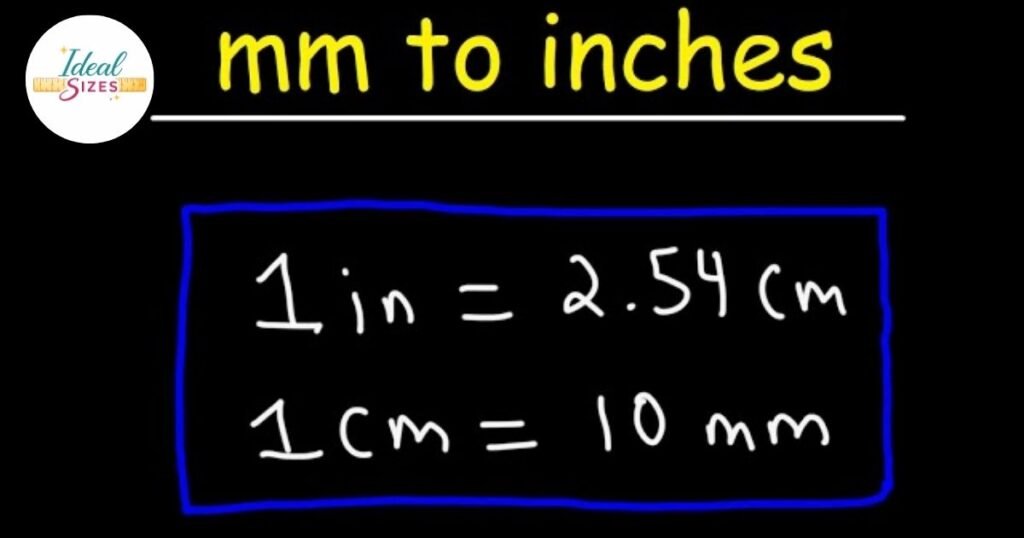
To convert inches back to millimeters, multiply the inch value by 25.4. With this reverse formula, you can enhance your ability to work across both measurement systems.
Step-by-Step Conversion of 14mm to Inches
To convert 14 millimeters to inches, follow these clear steps:
- Step 1: Write the standard formula: Inches = mm ÷ 25.4.
- Step 2: Substitute the value: 14 ÷ 25.4.
- Step 3: Perform the calculation: 14 ÷ 25.4 = 0.551181…
- Step 4: Round the result: 0.551 inches (approximately).
So, 14 mm equals approximately 0.551 inches. For quicker use, round it to 0.55 inches.
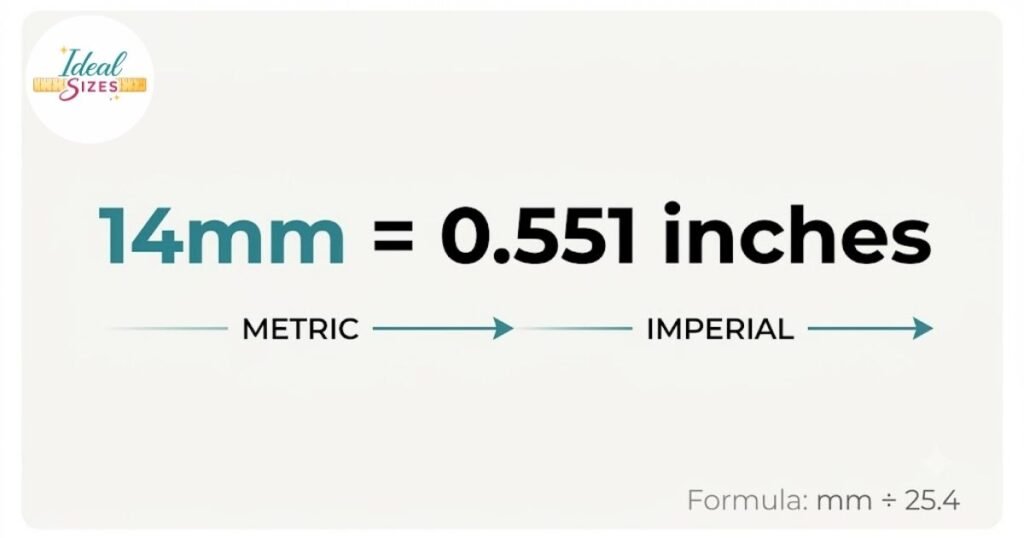
This method ensures accurate conversions between metric and imperial units. It’s especially handy for tasks like woodworking or sewing, where precise measurements matter.
Quick Conversion Chart (mm to Inches)
When you need to convert millimeters (mm) to inches, having a reference chart can be useful. For example, 50 mm is about 1.97 inches. This calculation makes it easy to switch between metric and imperial measurements, whether you’re working on a DIY project or measuring fabric. For everyday use, keeping a small conversion chart handy can save you time and effort.
| Millimeters (mm) | Inches (in) | Approx. Fraction |
| 10 mm | 0.394 in | 13/32 in |
| 12 mm | 0.472 in | 15/32 in |
| 14 mm | 0.551 in | 9/16 in (approx) |
| 16 mm | 0.630 in | 5/8 in |
| 18 mm | 0.709 in | 23/32 in |
| 20 mm | 0.787 in | 25/32 in |
Practical Real-Life Applications of 14mm
- Automotive and Mechanical Work: The 14mm bolt and nut size is integral in vehicles. It is commonly found in engine assemblies and suspension systems to ensure parts fit securely together.
- Construction Hardware: In construction, 14mm fasteners are essential for securing structural components. They are often used in beams, supports, and fixtures to provide strength and stability to buildings.
- Metal Sheets and Components: When measuring the thickness of metal sheets, a 14mm gauge is helpful. This ensures compatibility for various applications, from fabrication to repair.
- Plumbing Systems: For plumbing projects, 14mm pipes and tubes are often used. They connect fixtures such as faucets and toilet systems.
- Jewelry Design: In jewelry making, 14mm measurements help artisans create beautiful rings, beads, and chains.
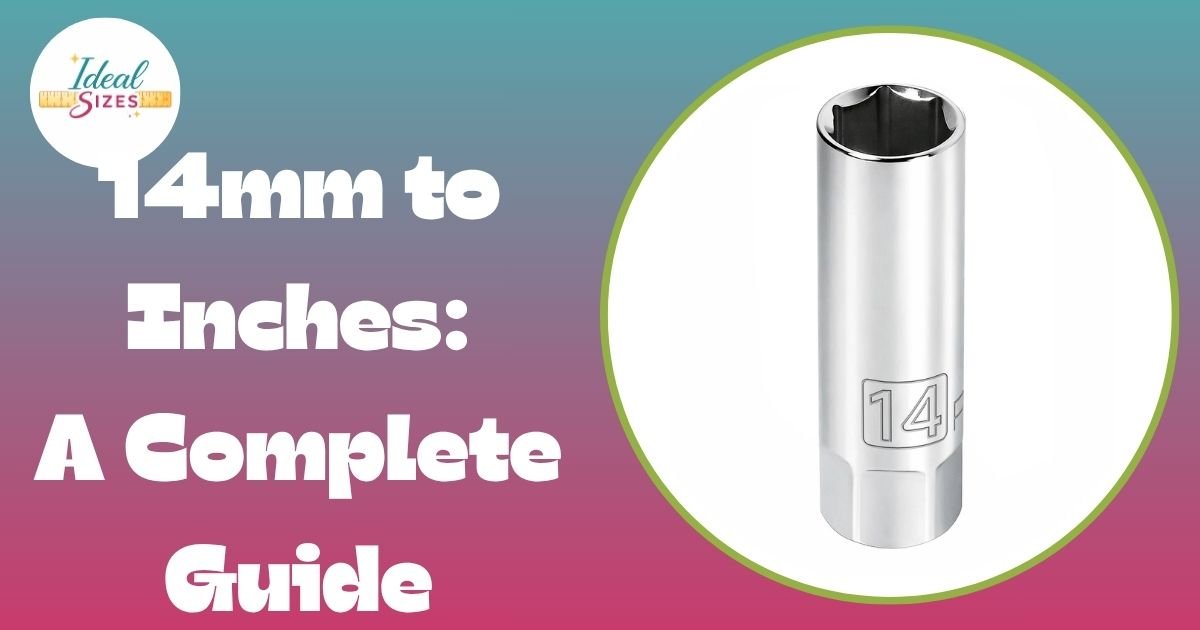
- Toolkits: The 14mm socket is a staple in mechanical toolkits. It allows for efficient work on machinery and vehicles.
- Electronics Assembly: In electronics, precise spacing is key. Components often use 14mm sizing for circuit boards and connections.
- DIY Home Repairs: Many DIY projects require standard metric fittings, including the 14mm size.
- Construction Measurements: A 14mm measurement is common in structural components, such as rebar or plywood. Builders rely on these specifications to ensure that their structures meet regulations and withstand environmental stress.
Visual Understanding of 14mm
The size of 14mm is roughly half an inch. It is very close to the thickness of a standard pencil eraser. The width of a small stack of coins can also help you grasp this size. Many USB sticks are slightly wider than 14mm.

A 14mm lens is also a popular choice in photography, especially for landscape and architectural shots. This lens offers an expansive field of view and captures more of the scene in a single frame.
Common Conversion Errors to Avoid
The following are common errors to avoid when converting measurements.
- Mixing Units Incorrectly: Confusing millimeters (mm) with centimeters (cm) can lead to significant errors. Remember that 1 cm equals 10 mm. If you mistakenly treat cm as mm, your final calculations will be off.
- Wrong Formula: A common pitfall is forgetting to divide by 25.4 when converting millimeters to inches. The correct formula is: inches = mm ÷ 25.4. If you skip this step, your results won’t be accurate.
- Early Rounding: Rounding numbers too soon in your calculations can reduce precision. Always wait until the final answer before rounding. This ensures your result is as precise as possible.
- Decimal Mistakes: Misplacing a decimal point can change your answer. Double-check your calculations to avoid these errors.
- Estimation instead of Calculation: Guessing values rather than using exact figures leads to inaccuracies. It’s vital to perform precise calculations for reliable conversions.
- Unit Reversal Error: If you accidentally multiply instead of dividing when converting mm to inches, you’ll end up with incorrect values.
- Inconsistent Precision: Using varying levels of rounding can change your final answer. Stick to a consistent rounding technique throughout your calculations.
- Ignoring Standard Value: It’s essential to remember that 1 inch equals exactly 25.4 mm. Using approximate values can lead to compounded errors in your conversions.
14mm in Fractional Inches
When converting 14 millimeters to fractional inches, the exact decimal value is 0.551 inches. In practical terms, this closely aligns with the common fractional inch of 9/16 inch, which is equivalent to 0.5625 inches. While 9/16 is slightly larger than 14 mm, it often serves as an approximation.
Conclusion
14 millimeters is equal to approximately 0.55 inches. Knowing how to convert between millimeters and inches is important, especially for tasks in construction or crafting. It helps you communicate measurements clearly. Understanding both systems can also prevent mistakes and ensure accuracy, whether you’re sewing, building, or simply measuring items. With the chart and formula, you can easily tackle similar conversions anytime.
FAQs
What is 14mm in cm?
To convert millimeters to centimeters, divide the number of millimeters by 10. In this case, to find out 14mm to cm, do the math: 14 mm ÷ 10 = 1.4 cm. So, 14 mm in cm is 1.4 centimeters.
What is 14mm in inches exactly?
14 mm is exactly 0.551181 inches. For a simpler number, round it to 0.551 inches. In many cases, people also round it further to about 0.55 inches for ease of use.
How much is 14mm to standard?
14 mm is approximately 1.4 centimeters. This is a straightforward conversion since both metric units are commonly used in measurements. In imperial terms, 14 mm is approximately 9/16 inch.
How to convert mm to Inches?
To convert millimeters (mm) to inches, just divide the number of millimeters by 25.4. For example, if you have 100 mm, calculate it as 100 ÷ 25.4, which equals about 3.94 inches.