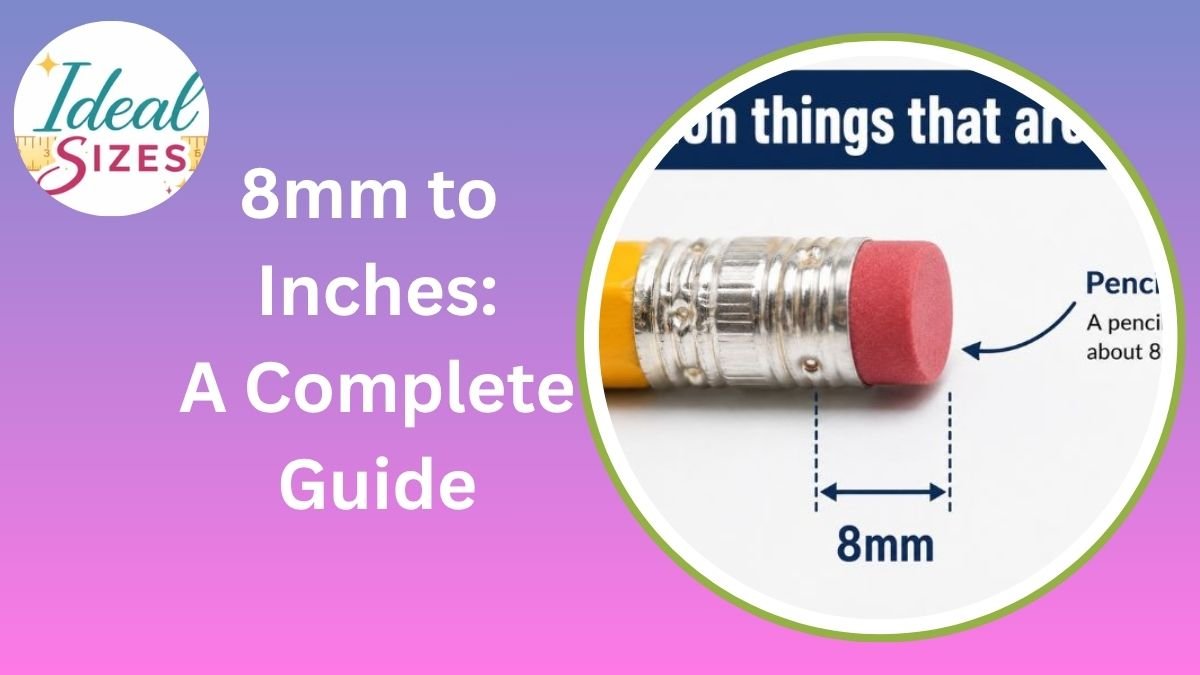
8mm to Inches: Exact Conversion, Formula, Conversion Chart & Practical Uses
Did you know that many everyday objects you use are measured in millimeters? For those unfamiliar, converting 8mm to inches may seem confusing at first. The conversion from millimeters to inches is essential for various fields, including construction and crafting. Accurately knowing that 8mm is approximately 0.31 inches can save you from mistakes.
This article will break down the exact conversion, share the formula, and provide a handy conversion chart for 8mm to inches. By the end, you’ll easily understand how to use these measurements, whether for crafting, DIY projects, or home improvement.
What Is 8mm in Inches?
8 mm to inches is about 0.31496063 inches. It rounds to 0.31 inches. It is slightly larger than 1/4 inch and smaller than 3/8 inch, with a close fractional equivalent of 5/16 inch (0.3125 inch). This conversion is essential for various fields, especially when dealing with precise measurements.
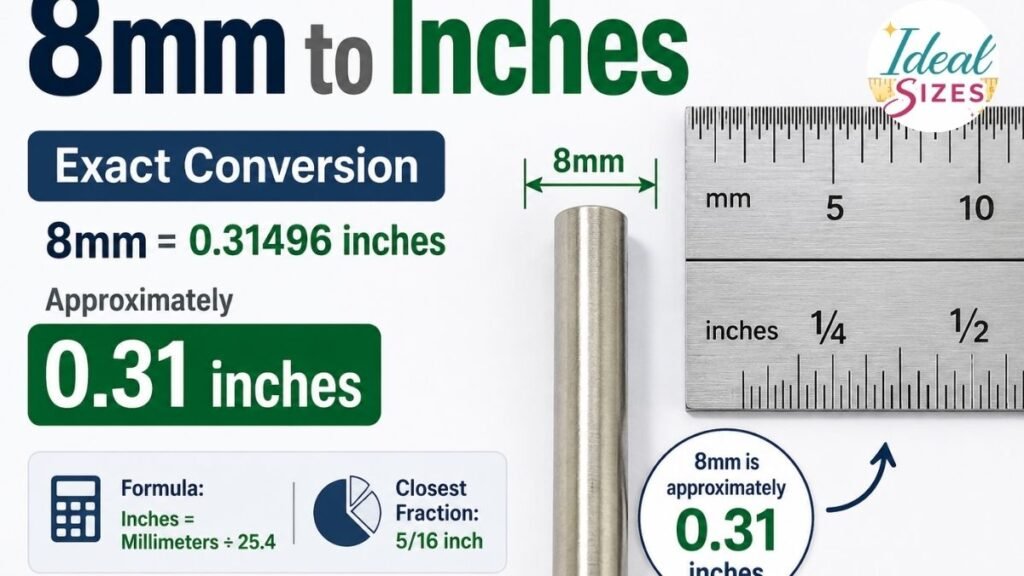
You often encounter 8 mm measurements in jewelry, where it’s essential for sizing beads and pearls. In hardware, metric bolts and screws often reference this size too.
| Measurement | Value |
| Exact | 0.31496 inches |
| Rounded | 0.31 inches |
| Fraction | About 5/16 inch |
8mm to Inches Conversion
To convert 8 mm to inches, start with the simple rule that 1 inch equals 25.4 millimeters. This means to find out how many inches 8 mm is, divide 8 by 25.4. Doing the math gives about 0.31496 inches. If you round this, it becomes 0.31 inches when rounded to two decimal places and 0.315 inches to three decimal places.
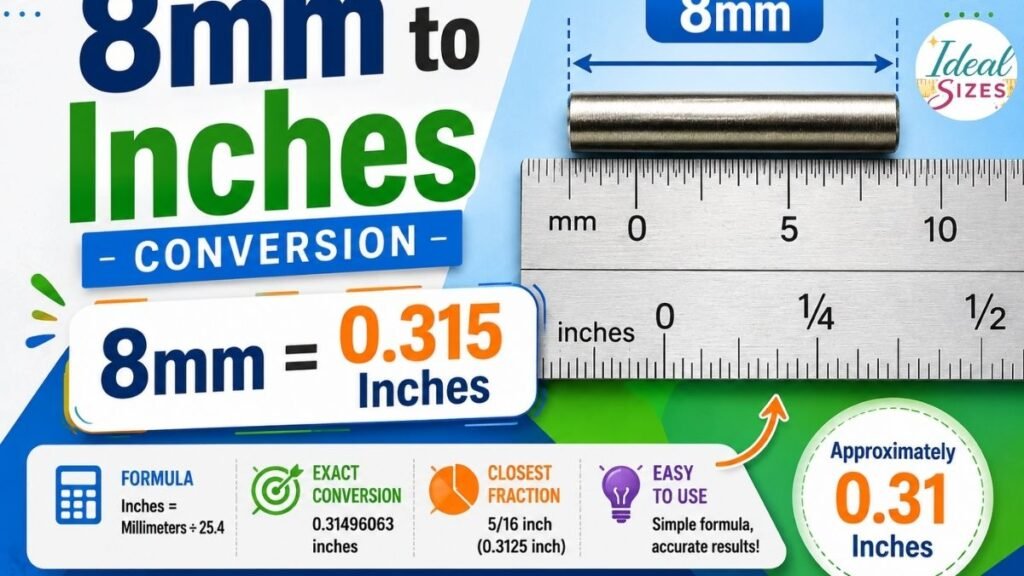
Formula to Convert Millimeters to Inches
To convert millimeters to inches, you can use the simple formula: Inches = Millimeters ÷ 25.4. 25.4 number comes from the fact that one inch is exactly 25.4 millimeters. This relationship helps us easily switch between these two popular measurement systems.
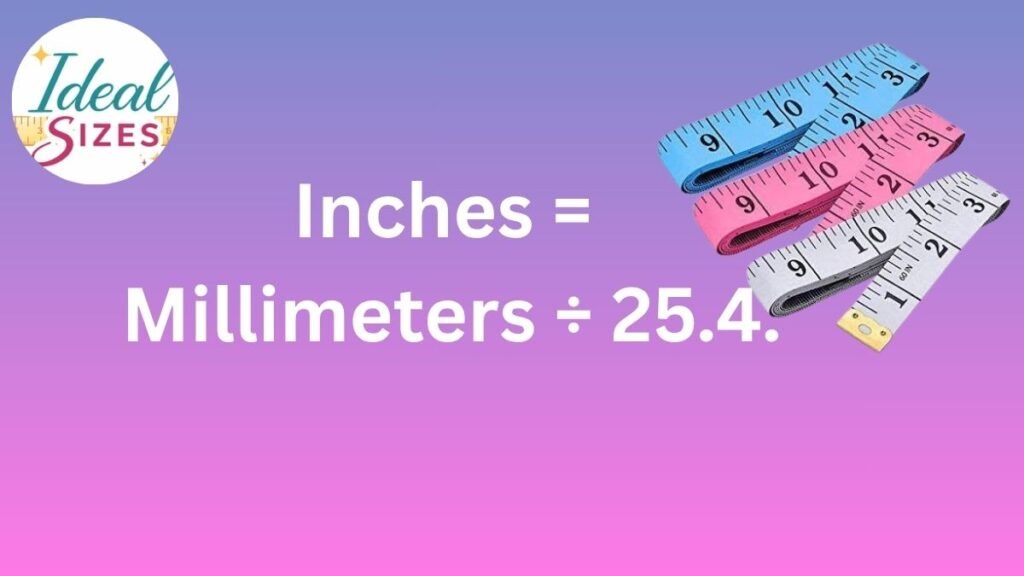
The reverse formula is: Millimeters = Inches × 25.4. This means you multiply the number of inches by 25.4 to find out how many millimeters that equals.
How to Convert 8mm to Inches (Step-by-Step)
To convert 8 mm to inches, follow a simple formula. Start with the formula: Inches = Millimeters ÷ 25.4. This means you divide the number of millimeters by 25.4 to get the equivalent in inches. In our case, we take 8mm and plug it into the formula: Inches = 8 ÷ 25.4.

Next, perform the calculation. Doing the math, you’ll find that 8 divided by 25.4 equals approximately 0.31496063 inches. This gives you a precise measurement, but rounding is often helpful. When rounded to two decimal places, the result is 0.31 inches. For greater precision, rounding to three decimal places yields 0.315 inches. In fractions, 8mm is close to 5/16 of an inch. So,
Step 1: Write the formula
To convert millimeters to inches, you can use this straightforward formula:
Inches = Millimeters ÷ 25.4
Step 2: Insert the value
Now, let’s plug in our number:
Inches = 8 ÷ 25.4
Step 3: Calculate
Perform the division:
8 ÷ 25.4 = 0.31496063 inches.
Step 4: Round the answer
You can round this value for simplicity:
- Rounded to 2 decimal places: 0.31 inches
- Rounded to 3 decimal places: 0.315 inches
- The closest fractional inch is 5/16 inch.
8mm in Decimal and Fractional Inches
In fractional terms, 8 millimeters to inches is close to 5/16 inch. Understanding this conversion is essential for various tasks, whether you’re DIYing at home or working on a craft project. It helps you ensure that everything fits perfectly and functions as intended.
| Type | Value |
| Exact Decimal | 0.31496 |
| Rounded (2 decimals) | 0.31 |
| Rounded (3 decimals) | 0.315 |
| Fraction | About 5/16 in |
8mm to Inches Conversion Chart
Using an 8 mm to inches conversion chart can help visualize these measurements easily. It’s not just about 8mm; a standard chart may include values like 10mm (0.393 inches) and 5mm (0.197 inches). For everyday tasks, such as buying hardware or working on home projects, having this information can improve accuracy.
| Millimeters | Inches |
| 1 | 0.0394 |
| 2 | 0.0787 |
| 3 | 0.1181 |
| 4 | 0.1575 |
| 5 | 0.1969 |
| 6 | 0.2362 |
| 7 | 0.2756 |
| 8 | 0.3150 |
| 9 | 0.3543 |
| 10 | 0.3937 |
| 12 | 0.4724 |
| 15 | 0.5906 |
| 20 | 0.7874 |
| 25 | 0.9843 |
| 30 | 1.1811 |
Practical Uses of an 8mm Measurement
An 8mm measurement can be found in various everyday applications. For instance, in photography, many camera lenses have an 8mm option for ultra-wide shots. This allows photographers to capture stunning landscapes or architectural details that might otherwise be difficult to fit into a standard frame. Here are some practical uses of an 8mm measurement.
Jewelry
The 8mm measurement is common in jewelry design. It’s the standard size for round beads to create bracelets and necklaces. It is the common diameter for freshwater and faux pearls. 8mm beads are also popular in prayer beads.
Bolts and Fasteners
In construction and machinery, the 8mm size plays a vital role. It’s commonly used for metric bolts and machine screws. You’ll find 8mm in hex nuts and washers. This size is also prevalent in automotive repair and furniture assembly.
Drill Bits
In home improvement, the 8mm drill bit is a must-have tool. It’s perfect for drilling through wood, plastic, and light metal. If you’re tackling masonry projects, there are specific 8mm bits designed for anchor holes.
Plumbing
In plumbing, 8mm measurements are essential, especially for outside-diameter plastic tubing. This size is commonly found in water filtration and irrigation systems. It works seamlessly with compatible push-fit and compression fittings.
Electronics
In electronics, 8mm is often used for spacers and standoffs in mounting circuit boards. This measurement is essential for small hardware assemblies and electronic enclosures. 8mm slots are perfect for cable routing.
Crafts and DIY
In crafts and DIY projects, 8mm is a beloved size. Whether you’re working with wooden, acrylic, glass, or resin beads, this measurement is a popular choice. It shines in leatherworking, adding decorative hardware to items.
Manufacturing and Engineering
An 8mm measurement plays a vital role in manufacturing and engineering. Precision mechanical parts often rely on this size for critical components like shafts, pins, and bushings. This measurement ensures that everything fits perfectly, which is essential for machinery to run smoothly.
Everyday Objects That Are About 8mm
Many everyday objects measure around 8mm. To visualize 8mm length in daily life, here are some of the most common examples.

- Standard Craft Bead: Many jewelry using 8mm craft beads. Their size is perfect for adding a pop of color to bracelets and necklaces. These beads come in various materials, from glass to wood.
- Freshwater Pearl: An 8mm freshwater pearl is a classic choice for elegant jewelry. This size is ideal for earrings and pendants.
- Mechanical Bolt Shaft: In construction and repair, an M8 bolt has a shaft about 8mm wide. This measurement is essential for fitting into specific machinery or structures.
- Plastic Tubing: For aquarium enthusiasts, 8mm plastic tubing is a common choice. This diameter is often ideal for adequate flow and circulation.
- Thick Charging Cable: Heavy-duty USB cables often have an 8mm thickness, including insulation. This size helps protect the internal wires.
- Small Marble: Many decorative marbles used in games or decor are about 8mm in diameter.
- Standard Pencil Thickness: A typical pencil has a diameter close to 8mm.
- Stack of Several Credit Cards: If you stack around 8-10 standard credit cards, you create a thickness of about 8mm.
Millimeters vs Inches
When measuring length, understanding millimeters and inches is essential. A millimeter is part of the metric system and is one-thousandth of a meter. On the other hand, an inch is part of the imperial system and equals 2.54 centimeters.
| Millimeters | Inches |
| Metric System | Imperial System |
| Used worldwide | Mostly US |
| Smaller unit | Larger unit |
| Engineering | Construction |
| Manufacturing | Carpentry |
Common Mistakes When Converting mm to Inches
- Converting millimeters (mm) to inches can be tricky if you’re not careful. One common mistake is using 2.54 instead of 25.4. Remember, 1 inch equals 25.4 mm, so using 2.54 will give you misleading results.
- Multiplying instead of dividing. You need to divide the millimeter value by 25.4 to get inches, not the other way around.
- Rounding too early can also lead to inaccuracies. It’s best to keep as many decimal places as possible during calculations before you round off your final answer.
- Forgetting decimal places can cause significant errors, especially with smaller measurements. And when using fractions, ensure you apply the correct conversions.
- Confusing millimeters with centimeters. It’s easy to confuse mm with cm, where 1 cm equals 10 mm. Always double-check your units to avoid this mix-up. Be mindful of decimal places; forgetting them can completely change your answer.
Related Metric to Inch Conversions
5 mm to Inches: 5 mm is approximately 0.197 inches. It’s often used in small mechanical parts and crafts.
6 mm to Inches: 6 mm equals about 0.236 inches. This is useful for precise measurements in design projects.
7 mm to Inches: It is roughly 0.276 inches. This size is common for beads and jewelry-making.
9 mm to Inches: 9 mm converts to around 0.354 inches.
10 mm to Inches: 10 mm equals about 0.393 inches. It’s a frequently encountered measurement in construction and fabrication.
12 mm to Inches: 12 mm translates to approximately 0.472 inches. This is a popular size for bolts and screws.
14 mm to Inches: When you hit 14 mm, you get near 0.551 inches. This size is often seen in automotive components.
15 mm to Inches: 15 mm equals about 0.590 inches.
20 mm to Inches: 20 mm converts to about 0.787 inches.
Understanding these conversions helps in various fields, from DIY projects to professional crafting. Whether you’re measuring fabric, electronic components, or creating art, these metrics will guide you accurately!
Conclusion
In conclusion, converting 8mm to inches is straightforward with the right formulas and charts. We’ve explored the exact conversion, which is approximately 0.315 inches. This simple calculation can help in various practical applications, whether you’re dealing with measurements in crafting, construction, or travel. Remember to keep this guide handy for quick reference. Now that you know how to convert measurements easily, why not start applying these conversions in your next project?
FAQs
What is 8mm in Inches exactly?
8 mm is equal to approximately 0.31496 inches. To get this value, we use the conversion factor where 1 inch is equal to 25.4 mm. If we round the result, 8 mm is about 0.31 inches when rounded to two decimal places.
Is 8 mm equal to 5/16 Inch?
No, 8 mm is not exactly equal to 5/16 inch, but they are very close. To be precise, 8 mm equals about 0.31496 inches. On the other hand, 5/16 inch is equal to 0.3125 inches. The difference between the two values is only about 0.00246 inches, which is roughly 0.0625 mm.
How to Convert Millimeters into Inches?
To convert millimeters into inches, you can use a simple formula. Divide the number of millimeters by 25.4. This is because one inch is equal to 25.4 millimeters. For example, if you have 8 millimeters, you would calculate it like this: 8 ÷ 25.4 = 0.31496063 inches. You can round this number for easier reading.
What is 8mm in Centimeters?
8 mm is equal to 0.8 centimeters. To understand this conversion, you can use a simple formula: divide the number of millimeters by 10. Since there are 10 millimeters in 1 centimeter, you just move the decimal point one place to the left.
What is the Closest Fractional inch to 8mm?
The closest fractional inch to 8mm is 5/16 inch. To break it down, 5/16 inch equals 0.3125 inches. On the other hand, 8mm is about 0.31496 inches when converted. The difference between 5/16 inch and 8mm is very small, only about 0.00246 inches.